Predictive Governance: How Analytics Is Rewriting Public Policy Decisions
By Brutnow Team |insights & Intelligence | Brutnow Media
Forget crystal balls; city halls and government agencies are now turning to data analytics and algorithms to shape the future of our communities. Welcome to the era of predictive governance.
For decades, public policy was often a game of reaction. A pothole needed to be reported, a crime had to be committed, and a public health crisis had to erupt before resources were deployed. This approach, while well-intentioned, was inherently slow and inefficient.
Today, a profound shift is underway. Fueled by vast amounts of data and sophisticated analytics, governments are moving from a reactive to a predictive model. This new paradigm, known as Predictive Governance, is quietly revolutionizing how policy decisions are made, from the local to the national level.
What Exactly is Predictive Governance?
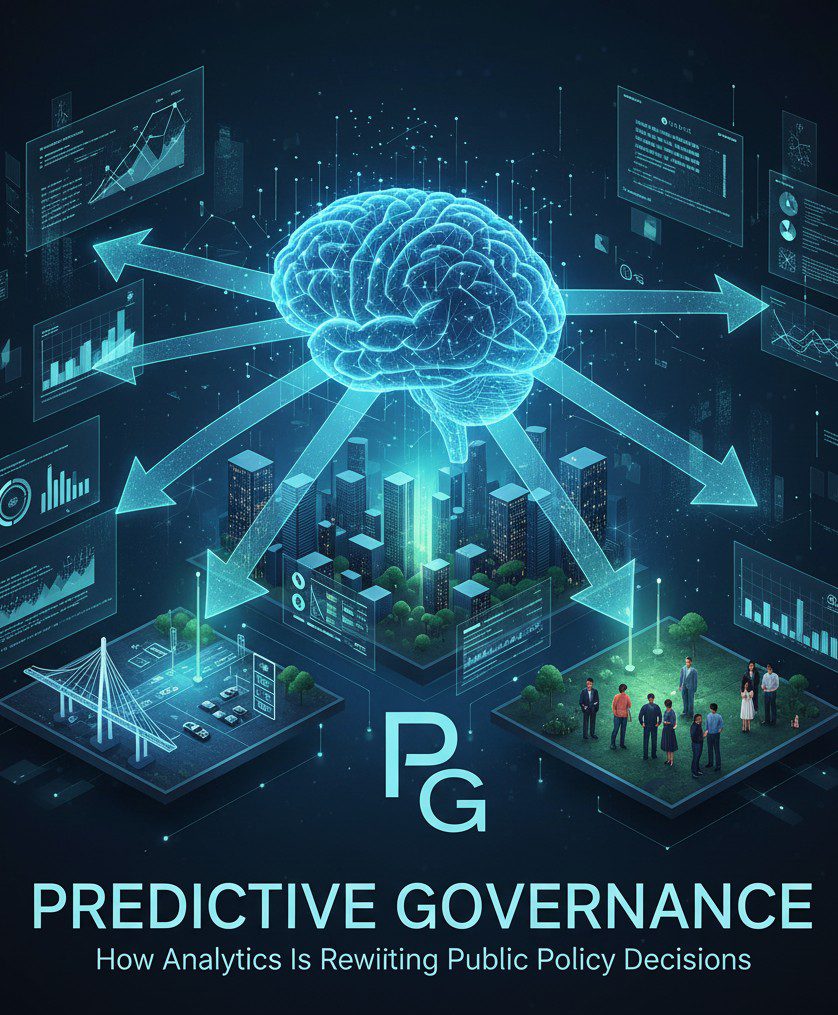
At its core, predictive governance uses historical and real-time data—combined with machine learning and statistical algorithms—to forecast future events and identify potential risks. This allows officials to allocate resources proactively, prevent problems before they occur, and design more effective policies.
Think of it as a weather forecast for civic life. Just as a meteorologist uses data models to predict a storm, a city planner can use similar techniques to predict which neighborhoods are at highest risk for lead pipe failure or which students are most likely to drop out of school.
Predictive Governance in Action: Real-World Examples
The applications are as diverse as government itself. Here are a few ways predictive analytics is already being deployed:
1. Public Health: During the COVID-19 pandemic, predictive models were crucial in forecasting case surges and allocating vaccines. Now, health departments are using analytics to identify communities at high risk for opioid abuse or diabetes, enabling targeted prevention programs and outreach.
2. Public Safety: Predictive policing, while controversial, has evolved. More forward-thinking applications now focus on place-based rather than person-based predictions. Cities like Los Angeles use data on building code violations, sanitation complaints, and economic factors to predict which buildings are at high risk for fire, allowing for proactive inspections.
3. Infrastructure Management: Instead of waiting for a water main to break, utilities are using sensor data and analytics to predict which pipes are most likely to fail. This “predictive maintenance” saves millions in emergency repairs and prevents service disruptions.
4. Education: School districts are using early-warning systems that analyze attendance, grades, and behavioral data to identify students who are at risk of not graduating. This allows counselors to intervene with support long before a student drops out.
The Double-Edged Sword: Benefits and Inherent Risks
The benefits of predictive governance are compelling:
· Efficiency: Tax dollars are spent preventing costly problems rather than cleaning up after them.
· Proactivity: Governments can address issues like public health crises and infrastructure decay before they harm citizens.
· Evidence-Based Decisions: Policy moves from ideological debate to data-driven strategy.
However, this powerful tool comes with significant risks that must be rigorously managed:
· Algorithmic Bias: If the historical data used to train a model is biased (e.g., reflecting past policing disparities), the predictions will perpetuate and even amplify those biases.
· The “Black Box” Problem: Some complex algorithms are difficult for even their creators to fully interpret, raising questions of transparency and accountability.
· Privacy Erosion: The hunger for more data can lead to increased surveillance and the erosion of individual privacy.
The Path Forward: Responsible Implementation
For predictive governance to be a force for good, experts agree on several key principles:
· Transparency: Governments must be open about what data they are using and what the models are designed to predict. The public has a right to know.
· Auditability: Algorithms must be regularly audited by independent third parties to check for bias and accuracy.
· Human-in-the-Loop: Predictive tools should inform, not replace, human judgment. A caseworker or police officer must always apply context and empathy to a data-driven recommendation.
· Strong Data Governance: Clear rules must be established for data collection, storage, and usage to protect citizen privacy.
“The goal is not to create an automated government,” says Dr. Anya Sharma, a leading researcher in civic technology. “The goal is to create a smarter, more responsive, and more equitable one. Data is the tool, but human wisdom must remain the guiding hand.”
The Future is Predictive
Predictive governance is no longer a futuristic concept; it is a present-day reality. As the technology matures, its role will only expand. The critical task for policymakers, technologists, and citizens alike is to engage in a robust public conversation about how we build these systems with fairness and accountability at their core.
The rewrite of public policy has begun. The question is no longer if we will use predictive analytics, but how we will use it to build a better society for all.